





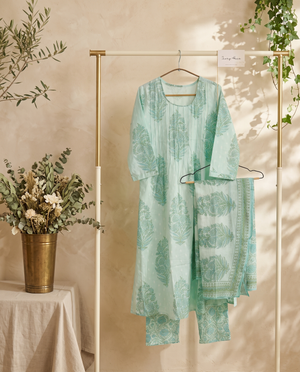


What Is Ajrakh Print? Block Print Suit Guide Singapore
Ajrakh is a centuries-old resist-dye hand block printing technique from the Kutch region of Gujarat (and historically Sindh, now in Pakistan), traditionally practised by the Khatri community. Cloth is printed and dyed in repeated stages using natural resists, mordants, and dyes — chiefly indigo and madder — to build up its signature deep blue and brick-red geometric patterns. Genuine Kutch Ajrakh now carries a Geographical Indication (GI) tag, and at Ivory Hues it appears on select pieces in our Sunehri collection.
Ajrakh Print at a Glance
- Technique: Resist-dye hand block printing — multiple rounds of resist, mordant, and dye, rather than a single printing pass
- Origin: Kutch, Gujarat, India — with historic roots in the Sindh region, now in Pakistan
- Community: Traditionally practised by the Khatri community of block printers and dyers
- Heritage status: Geographical Indication (GI) tag for Kutch Ajrakh, granted in 2024
- Fibre: Traditionally printed on cotton, using natural dyes and mordants
- Signature palette: Deep indigo blue and madder red, with black outlining and white resist areas
- Pattern style: Geometric, mirror-symmetric motifs, often echoing Islamic architectural and calligraphic design traditions
A Brief History of Ajrakh
Ancient roots, debated dates
Ajrakh's exact age is genuinely difficult to pin down, and it's worth being careful with the claims made about it. Some writers point to the similarity between Ajrakh-style patterns and the trefoil motifs on the "priest-king" statue from Mohenjo-daro, part of the Indus Valley Civilisation, to argue that resist-dye printing in this region could be thousands of years old. That connection is suggestive rather than proven — what's better documented is that the oldest surviving block-printed cloth fragments linked to this Gujarat tradition, recovered from a grave site in Cairo, Egypt, are estimated at roughly 600 to 800 years old. Between those two data points, the safest description is that Ajrakh is an ancient craft with a documented history stretching back several centuries, and a possible — but unconfirmed — lineage going back much further.
1630s — the Khatri community settles in Kutch
Ajrakh printing was originally practised in the Sindh region. Roughly 400 years ago, during the rule of Rao Bharmalji of Kutch (1586–1631), Khatri block printers and dyers migrated east and settled in Dhamadka, a village near Bhuj in Kutch, bringing the craft with them and establishing it as a local tradition that continued for generations.
2001 — the Gujarat earthquake and Ajrakhpur
The devastating 2001 Gujarat earthquake destroyed Dhamadka, including the water sources the Khatri printers relied on for dyeing. In its aftermath, the community resettled and built a new village, Ajrakhpur, a short distance away, which remains one of the main centres of Ajrakh production today alongside Dhamadka itself.
2024 — Geographical Indication recognition
In 2024, the Office of the Controller General of Patents, Designs and Trademarks granted a Geographical Indication (GI) tag to Kutch Ajrakh, formally recognising it as a product of this specific region and community, and protecting the name from being used for imitation prints made elsewhere.
What Makes Ajrakh Distinct?
A few features set genuine Ajrakh apart from an ordinary printed cotton:
- A long, multi-stage resist-dye process. Sources documenting the craft describe well over a dozen distinct stages — washing and treating the cloth, printing a resist paste, applying mordants, and dyeing — repeated across multiple rounds, with the cloth dried between stages. Depending on the piece and the workshop, the full process is generally described as taking anywhere from several days to a few weeks, rather than being completed in one sitting.
- Natural dyes, not a single print pass. Colour is built up gradually: indigo for the blues, madder root (or alizarin) for the reds, and iron-based mixtures for black, with the resist paste protecting the areas meant to stay white or a different colour at each stage.
- Near-mirror printing on both sides. Because the pattern is worked in stages with carved wooden blocks rather than printed once from the front, well-made Ajrakh cloth often shows a very close — sometimes near-identical — print on both the front and back, which is one way artisans and collectors judge the quality of a piece.
- Geometric, mirror-symmetric patterning. Motifs are typically arranged in a central repeating field with layered borders and corner pieces, drawing on geometric star, lattice, and floral forms. The name "Ajrakh" is often linked to the Arabic word azrak, meaning blue — a fitting reference given how central indigo is to the finished cloth, though other origin stories for the name also exist and there isn't full agreement among historians on which is correct.
Is Ajrakh Suited to Singapore's Climate?
Traditional Ajrakh is printed on cotton using natural dyes, which makes it a reasonable choice for Singapore's warm, humid weather in the same way that other pure cotton weaves in our range are. Cotton breathes and absorbs moisture more readily than synthetic fabrics, so an Ajrakh print suit tends to feel more comfortable over a long day out than a heavier or synthetic-blend alternative. As with any naturally dyed cotton, we'd recommend gentle hand washing in cold water and drying in the shade to keep the colours and print looking their best.
Shop Ajrakh Block Print in Singapore

Ajrakh block print appears on select pieces within our Sunehri collection — including deep teal and other tones printed with this traditional geometric technique. If you'd like to see how Ajrakh compares with other hand block printing styles we carry, our handblock print guide is a useful next read, and our Indian fabric guide covers pricing and care across everything we stock. Browse the Sunehri collection to see the current range available.
Frequently Asked Questions
What is Ajrakh print?
Ajrakh is a traditional resist-dye hand block printing technique from the Kutch region of Gujarat, India, and historically from the Sindh region. Cloth, usually cotton, is printed and dyed in multiple stages using carved wooden blocks, natural resists, mordants, and dyes — primarily indigo and madder — to build up its characteristic deep blue and red geometric patterns.
Where does Ajrakh originate from?
Ajrakh printing was originally practised in the Sindh region, now part of Pakistan. Around 400 years ago, the Khatri community of block printers and dyers migrated to Dhamadka, near Bhuj in Kutch, Gujarat, under the rule of Rao Bharmalji, and the craft has been rooted in Kutch ever since, including in the newer settlement of Ajrakhpur.
What colours are traditionally used in Ajrakh printing?
Ajrakh's signature palette is deep indigo blue and madder or alizarin red, along with black created from iron-based mixtures and white areas left by the resist paste. These natural dyes are applied in multiple stages rather than in a single print run, which is what gives genuine Ajrakh its depth of colour.
How long does it take to make Ajrakh fabric?
The exact timeline varies by workshop and by piece, but the process is well documented as involving well over a dozen distinct stages — washing, resist application, mordanting, and dyeing, with drying time between each — and is generally described as taking anywhere from several days to a few weeks to complete, rather than being finished in one session.
Does Ajrakh have Geographical Indication (GI) status?
Yes. In 2024, the Office of the Controller General of Patents, Designs and Trademarks granted a Geographical Indication (GI) tag to Kutch Ajrakh, officially recognising it as a traditional product of the Kutch region and its Khatri artisan community, and protecting the name from use on imitation prints made elsewhere.
Is an Ajrakh print suit suitable for Singapore's weather?
Yes. Ajrakh is traditionally printed on cotton, a breathable natural fibre that generally performs well in Singapore's warm, humid climate compared with heavier or synthetic fabrics. As with other naturally dyed cottons, gentle hand washing in cold water and shade-drying will help the print and colours last.