

What Is Jamdani Fabric? Jamdani Suit Set Singapore Guide | Ivory Hues
UNESCO Heritage Craft
What Is Jamdani Fabric? The World's Most Celebrated Handloom Cotton — in Singapore
Listed by UNESCO as an Intangible Cultural Heritage of Humanity, Jamdani is not just a fabric — it is a living art form woven thread by thread by hand. Here is everything you need to know, and how to wear it.
Shop Jamdani Suit SetsWhat Is Jamdani?
Jamdani is a handloom cotton fabric originating from the Dhaka region — today the capital of Bangladesh, historically the muslin capital of the world. The name comes from Persian: jam (flower) and dani (vase or vessel), referring to the floral motifs traditionally woven into the cloth. It has been produced by Bengali weavers for at least 500 years, and in 2013 UNESCO listed Jamdani weaving as an Intangible Cultural Heritage of Humanity.
What makes Jamdani genuinely different from any other Indian fabric is its technique. The patterns — flowers, geometric forms, paisley, lattices — are not printed onto the fabric or embroidered on top of it after weaving. They are created during weaving itself, by the weaver working with two shuttles simultaneously: one carrying the base thread, and one carrying the supplementary pattern thread. The pattern thread is worked by hand, motif by motif, row by row, into the fabric structure. Each pattern thread is a separate addition — cut and left dangling on the reverse of the fabric, which is why the back of a genuine Jamdani piece looks like a garden of loose threads.
How long does it take? A single metre of fine Jamdani can take two weavers working together 3–5 days to complete. A wedding saree in the finest Jamdani has been known to take six months. The Ivory Hues Malhar Resham suit set uses a more accessible Jamdani weave — still entirely handmade, but woven with a larger motif repeat that makes the creation time manageable and the price honest.
A Brief History of Jamdani
Shop Jamdani Suit Sets in Singapore
The Malhar Resham is our signature Jamdani piece — a princess-line suit set in a classic white-and-blue Jamdani weave. The woven motifs give the fabric its characteristic texture: when you run your fingertip across the surface, you feel the raised pattern threads. When you hold it to light, the motifs glow against the ground fabric.
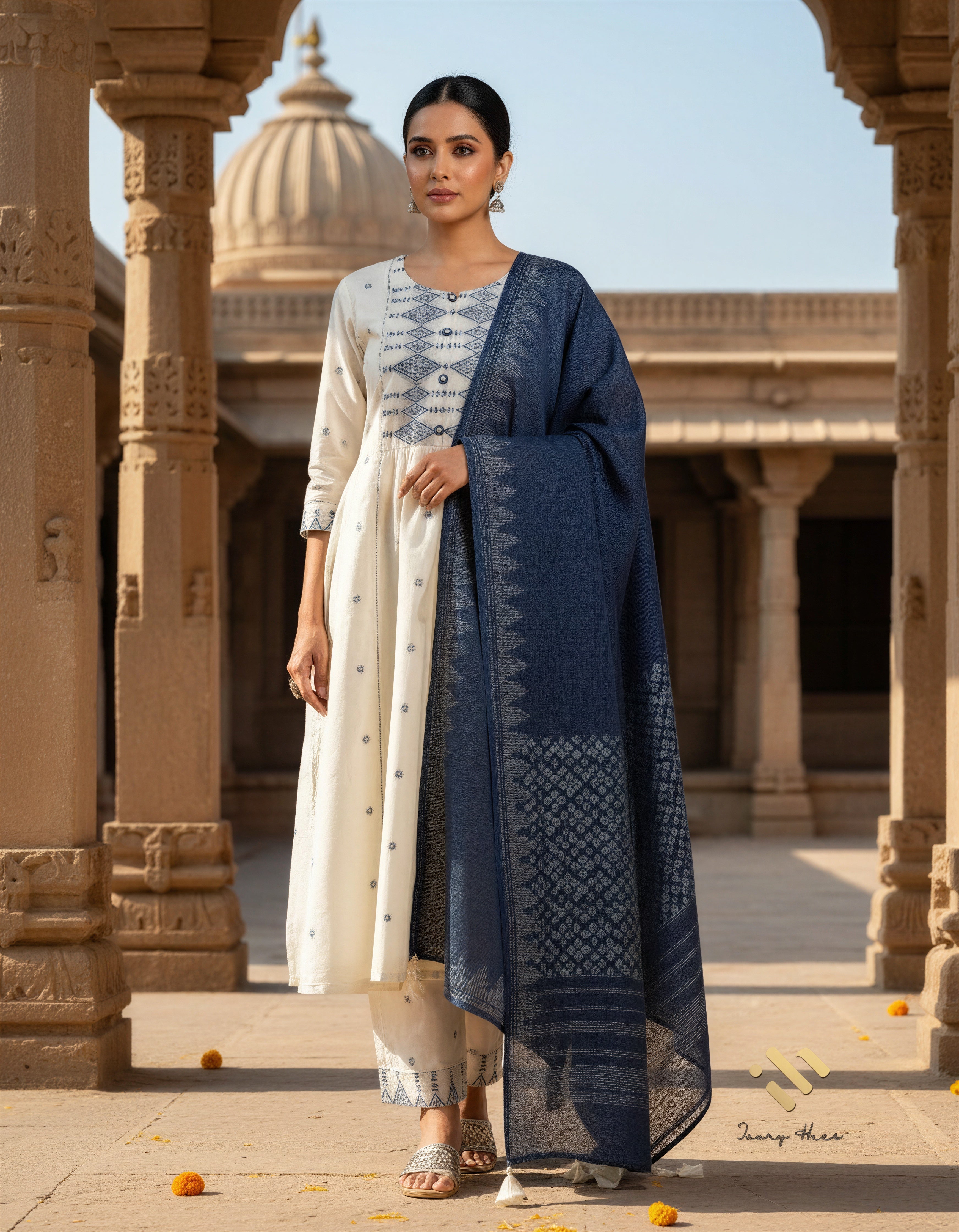
The Malhar Resham features a princess-line kurta cut — vertical seams that follow and gently flatter the body's contours. Read our princess line kurta guide to understand why this silhouette works for every body type.
How to Identify Authentic Jamdani
Because Jamdani's prestige is high, printed imitations are common. Here is how to tell the difference.
| Feature | Authentic Jamdani | Printed Imitation |
|---|---|---|
| Pattern technique | Woven into the fabric structure — feel raised threads on the surface | Printed on top — surface is flat, no texture variation |
| Reverse of fabric | Loose "floating" supplementary threads visible on the back | Back is plain or nearly identical to front |
| Pattern under light | Motifs appear to glow — the pattern threads catch light differently | Pattern looks the same in all lighting conditions |
| Touch / hand-feel | Slightly textured at motif areas, smooth at ground fabric | Uniformly smooth across the whole fabric |
| Price | Higher — reflects the handmade labour of weaving each motif | Lower |
How to Style a Jamdani Suit Set
For Festive & Cultural Occasions
- Wear the full three-piece set — kurta, churidar, dupatta. The Jamdani's woven texture is the statement; let the fabric speak.
- Pin the dupatta at the shoulder with an antique gold brooch for a structured, elegant look.
- Jewellery: antique gold works best with Jamdani's heritage feel. Jhumkas, a temple necklace, or a Kundan set all work well.
- Footwear: embroidered juttis or kitten-heel sandals.
For Everyday & Office Wear
- Wear the kurta alone with slim white or ivory trousers and flat footwear. The Jamdani weave is refined enough for a smart office setting.
- Skip the dupatta for a more contemporary, paired-back look.
- Minimal jewellery — a single pair of gold studs or a small chain. The woven motifs are decoration enough.
Colour Notes — White & Blue Jamdani
The Malhar Resham's white-and-blue Jamdani is one of the most classic Indian textile colour combinations — it appears across Bengali, Assamese, and Odishan weaving traditions. In Singapore, white-and-blue reads as both traditional and refreshingly modern. It works for Onam (white is traditional), Deepavali (colourful accessories transform it), and year-round cultural and social occasions.
Caring for Jamdani
-
Hand wash in cold water only
Never machine wash Jamdani. The supplementary woven pattern threads can snag, pull, or break in a machine. Cold water hand wash with a gentle detergent preserves both the weave structure and the colour. -
Handle the fabric gently — no scrubbing
Swirl gently in the water. Do not rub, scrub, or wring. The pattern threads are fragile where they float on the reverse — aggressive handling can pull them loose. -
Roll in a towel to remove water
Lay the wet fabric on a clean dry towel, roll it up, and press gently. Repeat with a fresh towel if needed. This removes water without distorting the weave. -
Dry flat in shade
Hang-drying can stretch Jamdani unevenly. Lay flat on a clean surface in the shade until fully dry. Singapore's humidity means this may take several hours indoors. -
Iron on low, on the reverse, with a pressing cloth
Ironing on the front of the fabric can flatten or damage the raised woven motifs. Always iron on the reverse through a thin cotton pressing cloth.
Frequently Asked Questions
© Ivory Hues Singapore · www.ivoryhues.sg · Free island-wide delivery · Indian ethnic wear for women