






What Is an Angrakha? Angrakha Kurta Guide Singapore
An angrakha is a kurta-style garment defined not by its length or fabric but by its front closure: instead of opening straight down the centre like a regular kurta, an angrakha wraps diagonally across the chest, with one panel overlapping the other and fastening at the side with fabric ties instead of buttons. That asymmetric wrap-front line — running from shoulder to hip rather than straight down the middle — is the one feature that makes an angrakha an angrakha, whether it's a centuries-old court robe or a modern cotton kurta.
Angrakha at a Glance
- Defining feature: Asymmetric, diagonal wrap-front closure
- Fastening: Fabric ties (dori) at the side, not buttons or a zip
- Historical origin: Mughal-era royal and noble court dress, 16th century onward
- Originally worn by: Men, as court and military attire; adopted more widely over time, including by women
- Modern form: A kurta or co-ord top with an angrakha-style wrap front as the key design detail
- At Ivory Hues: Found across the Sunehri, Gulmarg, and Meher collections, in breathable cotton with handblock prints
What Makes an Angrakha Different From a Kurta?
A standard kurta opens straight down the centre front — a single vertical placket, usually closed with buttons or left as a simple slit. An angrakha replaces that with two overlapping front panels set at an angle: one panel crosses over the other diagonally, and the join is secured at the side of the chest or waist with fabric ties rather than a button line. The result is a visible diagonal seam running across the chest, instead of a straight one down the middle.
This is also what separates an angrakha from an anarkali, a silhouette built around a fitted bodice flaring into a long frock rather than any particular front closure — the two get confused since both trace back to Mughal-era court wear, but one is about how the front closes, the other about the overall shape. For a broader comparison of silhouettes, our Kurta vs Kurti vs Anarkali vs Co-ord Set guide covers those distinctions in more depth. Because the closure sits at the side rather than the centre, an angrakha also tends to sit looser and more adjustable across the chest than a fitted, button-front kurta.
A Brief History of the Angrakha
Name and Origins
The word "angrakha" is generally traced to Sanskrit roots meaning "body protector," an etymology several textile historians connect to the garment's early use as a protective over-robe rather than pure decoration.
Mughal Courts, 16th Century Onward
The angrakha is most closely associated with Mughal court dress from the 16th century onward, where it was standard attire for noblemen, worn over fitted trousers such as churidar or pyjama. Fabric, length, and flare signalled rank — finer silks, brocades, and more voluminous cuts were reserved for higher-status wearers, while soldiers and attendants wore shorter, simpler cotton versions, sometimes with a quilted inner layer.
Why the Asymmetric Wrap?
Sources differ on exactly why the wrap-front design took hold — treat this as overlapping, documented explanations rather than one confirmed origin story. The tie-fastened, adjustable side closure made the garment easier to move in than a fitted, buttoned front, which mattered for soldiers wearing it on horseback and in combat. Its open, layered construction is also credited with better airflow in the subcontinent's heat. And the "body protector" name itself points to an early, more armour-adjacent role, later softened into court fashion. All three point the same direction: function likely shaped the silhouette before it became decorative.
Beyond the Mughal Court
Rajasthani royal and warrior households adapted the angrakha into their own regional forms, often as shorter, brightly dyed cotton versions suited to a hotter, drier climate and easier movement. By the 19th century, the style had moved well beyond court and military dress into everyday cotton garments, and it came to be worn by both men and women across different regions — evolving from a specifically male court and military garment into a silhouette available to any wearer.
Styling an Angrakha-Style Kurta Today
Contemporary angrakha-style pieces rarely attempt to reconstruct the full court robe. Instead, most retailers — Ivory Hues included — use the wrap-front as a styling detail on an otherwise familiar kurta or co-ord top: the asymmetric closure and side ties are kept, but the garment is cut and proportioned like modern womenswear rather than a historical court robe.
- Everyday wear: An angrakha kurta in cotton, worn over leggings or straight trousers, with the diagonal wrap-front doing the visual work — minimal jewellery is enough.
- Festive occasions: Choose an angrakha piece with handblock or Kalamkari prints, paired with a dupatta and juttis, for a look that reads traditional without the volume of a full anarkali.
- Layering: Because the wrap sits at an angle rather than centred, an angrakha top pairs well with a plain-coloured bottom that doesn't compete with the diagonal line.
Shop Angrakha-Style Pieces in Singapore

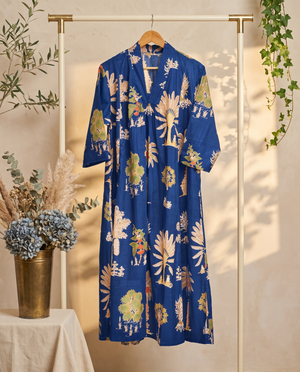
Sunehri Tashan, pictured above, is a blue-and-maroon cotton angrakha suit finished with handblock prints — a good example of how the wrap-front detail looks in breathable, everyday-appropriate cotton. Beyond this piece, the Sunehri collection, the Gulmarg collection, and the Meher collection each include angrakha-style kurtas and suits in cotton with handblock printing. Browse all three to see the current range of angrakha pieces available.
Frequently Asked Questions
Is an angrakha the same as a kurta?
Not quite. An angrakha is a specific type of kurta-style garment, distinguished by its asymmetric, diagonal front closure that wraps and ties at the side, rather than the straight centre-front opening of a standard kurta. Every angrakha is a kind of kurta, but not every kurta is an angrakha — the wrap-front closure is what sets it apart.
What does the word "angrakha" mean?
The name is generally traced to Sanskrit roots meaning "body protector," an origin historians connect to the garment's early use as a protective over-robe — sometimes with a quilted inner layer — before it developed into a decorative court and, later, everyday garment.
Is the angrakha wrap style only for women?
No, and historically it was the opposite. The angrakha originated as men's attire — standard court and noble dress in the Mughal empire from the 16th century onward, and also worn by soldiers in simpler forms. It was adopted more widely over the following centuries, and today angrakha-style pieces are made and worn across genders, though modern retail collections such as Ivory Hues' typically present it as womenswear.
How do you tie an angrakha?
A traditional angrakha closes with fabric ties, known as dori, set inside and outside the overlapping front panels. The inner panel wraps across the chest first and ties at the side or back, then the outer panel wraps over it in the same direction and ties again at the side, so both layers sit hidden beneath the visible diagonal seam. Modern angrakha-style kurtas often simplify this into a single side tie or hook for everyday convenience.
Can angrakha style be worn casually?
Yes. A cotton angrakha kurta worn with leggings or trousers works well as casual or everyday wear, especially in a warm, humid climate — the diagonal wrap-front adds visual interest without requiring the dupatta, jewellery, or draping a festive outfit calls for. Save prints and richer colours for more dressed-up occasions and keep it plain and light for daytime wear.
What's the difference between an angrakha and an anarkali?
They describe different parts of a garment. An angrakha refers to the front closure — an asymmetric, tie-fastened wrap across the chest. An anarkali refers to the overall shape — a fitted bodice that flares into a long, often floor-length frock. Both are linked to Mughal-era court dress, but a garment can be cut as an anarkali without an angrakha-style closure, and an angrakha-style top is usually a straighter kurta shape rather than a flared frock.