








What Is Sanganeri Print? Rajasthan Hand Block Guide
Sanganeri print is a hand block printing technique from Sanganer, a town about 16km south of Jaipur in Rajasthan, best known for its fine, multi-colour floral and botanical motifs stamped onto a light or white cotton ground using hand-carved wooden blocks. It is a Geographical Indication (GI) protected craft — the certificate was granted in March 2010 — meaning the name "Sanganeri" is legally tied to textiles printed in and around the Sanganer region, not simply to a style that can be reproduced anywhere.
What Is Sanganeri Print?
Sanganeri is a direct hand block printing tradition — dyes are stamped straight onto the fabric with carved wooden blocks, rather than applied through a resist paste for every colour. What sets it apart from other Rajasthani block prints is its restraint: airy floral sprigs, buds, and trailing vines (often called booti or buttis when small and repeating) are printed in careful registration across a pale or white cotton base, leaving generous open ground between motifs. The effect is delicate and garden-like rather than dense or heavy.
- Technique: Hand block printing, with a separate carved block for each colour and outline
- Origin: Sanganer, Rajasthan (near Jaipur)
- GI status: Registered Geographical Indication, certificate granted 2010
- Signature motifs: Fine florals, buds, and trailing botanical sprigs (booti/buttis)
- Traditional ground fabric: Light or white cotton
- Traditional dyes: Natural, vegetable-based colourants
A Brief History of Sanganeri Print
Block printing in Sanganer is generally traced to the late 16th and early 17th centuries, when Chippa printer families fled unrest in Gujarat during the conflicts between the Marathas and the Mughals and resettled in Rajasthan, including in Sanganer, Bagru, and the nearby village of Jahota. Sanganer's location on the Sahibi river was a practical draw as much as anything: the soft, mineral-light river water was well suited to washing and rinsing printed cloth, which helped the town grow into a dedicated printing centre over the following generations.
The craft flourished under Mughal and Rajput patronage — the 16th and 17th centuries were a period of strong demand for fine, intricately patterned textiles at court, and Sanganer's printers built a reputation for exceptionally fine, closely registered floral work. By the height of the East India Company's trade with India, Sanganeri-style calico prints were being exported to Europe in significant volume, carrying the town's floral printing style well beyond Rajasthan. That makes the tradition roughly 400 years old, with printer families in Sanganer still practising hand block printing today, largely unchanged in its core method even where dyes and export markets have modernised.
What Makes Sanganeri Print Distinctive?
A handful of features are used to identify genuine Sanganeri work:
- Light, breathable ground: Traditionally printed on white or off-white cotton, which keeps the floral motifs crisp and legible
- Fine, multi-colour floral motifs: Delicate botanical patterns — flowers, buds, creepers, and small repeating booti — rather than bold geometric or animal forms
- Precise multi-block registration: Each colour and outline is printed from its own carved block, and skilled printers align successive blocks so closely that the joins are barely visible
- Generous open background: Motifs are spaced out rather than packed edge to edge, giving the print an airy, uncluttered feel
- Natural dye heritage: Traditional Sanganeri printing used vegetable and mineral-derived dyes, though many pieces sold today use fabric-safe synthetic dyes for colourfastness and consistency
How Is Sanganeri Different from Bagru and Ajrakh?
All three are Rajasthan-linked hand block printing traditions and share some Chippa-community history, but the finished look is quite different. Bagru print, from the nearby town of Bagru, tends toward darker, earthier tones — indigo, black, and maroon — often on a mud-resist (dabu) base, giving it a more rustic, grounded character than Sanganeri's pale florals. Ajrakh is a separate tradition altogether, rooted in the Kutch region on the Gujarat–Sindh border, built around deep indigo and madder-red dyes in bold, geometric, mirror-symmetric patterns through a lengthy multi-day resist-and-dye process — visually and technically distinct from Sanganeri's lighter, single-pass floral printing.
Is Sanganeri Print Suitable for Singapore's Climate?
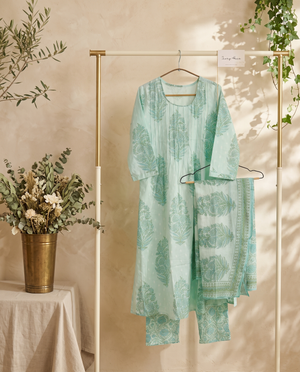
Because it is traditionally printed on cotton, Sanganeri fabric shares cotton's natural breathability and moisture absorption, which makes it a practical choice for Singapore's warm, humid weather. A light cotton kurta or co-ord set in Sanganeri print sits comfortably against the skin for daytime wear, indoor gatherings, and travel between air-conditioned and outdoor spaces, without the heaviness of richer festive fabrics.
Shop Sanganeri Print in Singapore
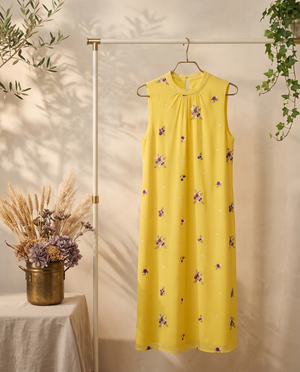
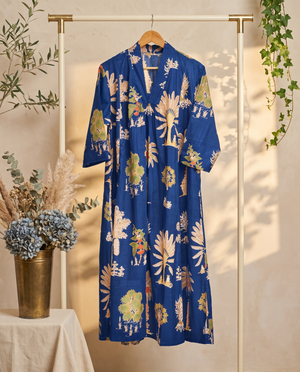
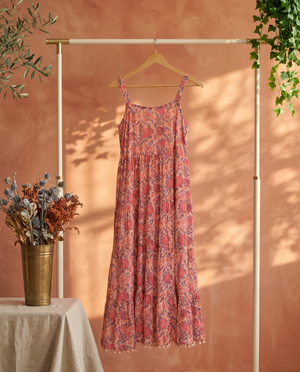
At Ivory Hues, the Sanganeri hand block printing technique appears across a couple of our collections. The Malhar collection is built around time-honoured Sanganeri and Bagru block printing techniques, and the Sunehri collection also carries pieces printed in the Sanganeri style — including the Sunehri Gulaal, a red angrakha cotton co-ord set with Sanganeri print.

Browse the Malhar collection and the Sunehri collection to see the current range of Sanganeri-print pieces available in Singapore.
Frequently Asked Questions
What is Sanganeri print?
Sanganeri print is a hand block printing tradition from Sanganer, a town near Jaipur in Rajasthan, known for its fine, multi-colour floral and botanical motifs printed onto a light or white cotton ground using hand-carved wooden blocks. It is protected as a Geographical Indication, with the GI certificate granted in 2010.
What does the Sanganeri GI tag actually protect?
The Geographical Indication registration ties the name "Sanganeri" to hand block and screen-printed textiles produced in and around Sanganer, Rajasthan, using the region's traditional printing methods. In practical terms, it means textiles made elsewhere cannot legally be marketed in India under the "Sanganeri" name, protecting the craft's regional origin and the livelihoods of the printers who practise it there.
How old is the Sanganeri hand block printing tradition?
The craft is generally traced back roughly 400 years, to the late 16th and early 17th centuries, when Chippa printer families migrated from Gujarat to Rajasthan and settled in Sanganer, Bagru, and nearby Jahota. It grew steadily under Mughal and Rajput-era patronage and later became a significant export textile during the East India Company period.
What is the difference between Sanganeri and Bagru print?
Sanganeri print is typically worked on a light or white cotton ground with fine, multi-colour floral motifs and generous open space between patterns. Bagru print, from the neighbouring town of Bagru, tends to use darker, earthier natural dye tones — indigo, black, and maroon — and in some variants uses a mud-resist technique called dabu, giving it a bolder, more rustic look than Sanganeri's delicate florals.
Is Sanganeri print the same as Ajrakh print?
No. Sanganeri and Ajrakh are distinct traditions. Sanganeri comes from Sanganer in Rajasthan and features fine floral motifs on a light cotton ground. Ajrakh originates in the Kutch region on the Gujarat–Sindh border and is built around deep indigo and madder-red dyes in bold, geometric, mirror-symmetric patterns, produced through a longer, multi-stage resist-dyeing process.
Is Sanganeri print cotton good for Singapore's weather?
Yes. Sanganeri print is traditionally done on cotton fabric, which is breathable and naturally suited to warm, humid conditions like Singapore's. A cotton kurta or co-ord set in Sanganeri print is comfortable for everyday wear, daytime outings, and cultural or festive occasions without feeling heavy in the heat.