







What Is Kasavu? Kerala Cotton Guide for Singapore
Kasavu is the golden zari border woven into unbleached, off-white cotton — the fabric and finish behind Kerala's most recognisable textile tradition, and the reason a "kasavu saree" or "kasavu mundu" always looks the same at a glance: cream cloth, gold edge. It is worn across Kerala year-round, but is most closely tied to Onam, the state's biggest harvest festival — which is why Ivory Hues named our Onam collection after it and built the range around gold-bordered cotton pieces. Here is what kasavu actually is, where it comes from, and how to shop it in Singapore.
Kasavu at a Glance
- Fibre: Unbleached, off-white or cream handloom cotton
- Border: Zari — historically real gold or silver thread, today usually metallic or synthetic zari
- Origin: Kerala, India — closely associated with weaving towns such as Balaramapuram and Chendamangalam
- Heritage status: Balaramapuram handloom holds a Geographical Indication (GI) tag, granted in 2009; Chendamangalam's handloom cluster carries its own GI recognition
- Traditional garment forms: Mundu (the wrap-cloth), and mundum neriyathum / settu-mundu — the traditional two-piece drape that predates the modern stitched-style saree
- Weight: Light to medium, depending on yarn count
- Most associated with: Onam, Kerala's harvest festival
What Is Kasavu, and Where Does It Come From?
Strictly speaking, "kasavu" refers to the zari itself — the fine gold or silver thread worked into the border and, sometimes, the pallu of the cloth. Over time the word came to describe the fabric and garments made from it too, so "kasavu saree," "kasavu mundu," and "kasavu fabric" are used interchangeably to mean the same thing: plain, unbleached cotton finished with a metallic gold border.
The garment predates the modern draped saree. Kerala's traditional women's wear was the mundum neriyathum, also called settu-mundu — a two-piece set of a lower cloth (mundu) and an upper cloth (neriyathu), both in the same cream cotton with a matching kasavu border, worn without a stitched blouse or saree-style pleats. The single-piece kasavu saree familiar today is a more recent adaptation of this older drape, and both forms are still worn in Kerala.
A Brief History of Kasavu Weaving
Early origins
The two-piece mundum neriyathum is recorded as everyday and ceremonial wear in Kerala long before the region's textile industry took its modern shape, with the fabric's origins traced back many centuries.
Early 19th century — royal patronage and Balaramapuram
The Balaramapuram weaving tradition, one of the main clusters associated with kasavu today, dates to the early 1800s, when Travancore's Maharaja Balarama Varma and his chief minister brought Shaliya weaving communities from present-day Tamil Nadu to weave mundu, neriyathum, and sarees for the royal household. This patronage established fine-count, hand-spun cotton with a gold or silver zari border as Kerala's signature weave — a craft tradition now well over 300 years old.
Colonial-era trade and GI recognition
As Kerala's handwoven cotton and its zari borders became known beyond the royal court, Dutch and Portuguese trading interests took note during the colonial period. Much more recently, in 2009, Balaramapuram's handloom cluster received Geographical Indication (GI) status from the Government of India, protecting the name for genuine handloom cotton woven within that cluster; Chendamangalam, another historic weaving town linked to kasavu-bordered cotton, carries its own GI tag too.
Today
Handloom weavers in Balaramapuram and Chendamangalam continue producing kasavu cotton, alongside power-loom versions that carry the same cream-and-gold look at a lower price. Off-white cotton with a gold border remains instantly recognisable as "Kerala," however it was woven.
What Makes Kasavu Distinct?
A few things set kasavu apart from other gold-bordered Indian textiles:
- An unbleached, undyed base. Unlike most festive Indian fabrics, kasavu cotton isn't dyed — its cream colour is the natural shade of the handloom yarn, left unbleached rather than whitened.
- The border does all the work. Decoration sits almost entirely in a gold zari border, sometimes with a matching band along the pallu — no all-over print or colour competing for attention.
- Regional, protected weaving. Genuine kasavu handloom is tied to specific Kerala clusters with GI protection, much like Chanderi or Banarasi silk are tied to their own home towns.
- Two historic garment formats. Few Indian textile traditions carry both an older two-piece drape (mundum neriyathum) and a newer single-piece saree, worn side by side today.
Why Cream and Gold, Not Jewel Tones? The Onam Color Story
Compared to the deep reds, pinks, and oranges typical of North Indian festive dressing — the jewel-tone palette you'd expect for Deepavali — kasavu's cream-and-gold restraint can look almost minimalist. That's the point. The pale, unbleached cotton reads as understated and pure rather than showy, while the gold border alone carries the festivity, echoing the golden Pookalam flower carpets and ripened paddy fields that give Onam its harvest meaning. Where Deepavali's colour story leans into abundance through saturation and shine, Onam's leans into abundance through simplicity — a plain, natural cloth elevated by one line of gold. It's a genuinely different way of dressing up.
Is Kasavu Suited to Singapore's Climate?
Yes. Kasavu is, at its core, pure cotton — one of the most breathable natural fibres available, and comfortable in Singapore's warm, humid weather whether for an indoor Onam gathering or a short walk between air-conditioned spaces. Because the embellishment sits only in the border rather than across the whole cloth, kasavu-style pieces also tend to be lighter than heavily embroidered festive fabrics, making them an easy choice for Singapore's year-round heat rather than a strictly cool-season option.
Shop Kasavu in Singapore

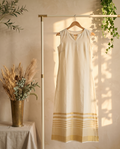
Our Onam collection is named directly after the festival kasavu is best known for, bringing that gold-bordered cotton look into easy, ready-to-wear silhouettes — including the Thulasi, a cotton dress finished with a golden kasavu border hem. Rather than a traditional mundu or saree drape, pieces in the collection translate the same cream-cotton-plus-gold-border idea into everyday dresses and sets. Browse the Onam collection to see the current range.
Frequently Asked Questions
What is kasavu fabric?
Kasavu is unbleached, off-white or cream handloom cotton from Kerala, India, finished with a gold-coloured zari border. The word technically refers to the gold or silver zari thread itself, but it is commonly used to describe the whole fabric, saree, or mundu made with this cream-and-gold combination.
Is kasavu the same as a kasavu saree?
Not exactly. Kasavu is the fabric and border style; a kasavu saree is one garment made from it. The same cream cotton with a gold border also appears in the mundu and in the mundum neriyathum, or settu-mundu — the two-piece Kerala drape that came before the modern stitched saree.
Is kasavu cotton or silk?
Kasavu is traditionally pure cotton. The gold or silver element is limited to the zari border thread, not the body of the fabric, which distinguishes it from silk-and-zari textiles like Kanjivaram or Banarasi, where zari work often covers much of the cloth.
Why is kasavu associated with Onam?
Onam is Kerala's major harvest festival, typically falling in August or September per the Malayalam calendar, commemorating the mythical King Mahabali's annual return. Kasavu's cream-and-gold cotton has long been the traditional festive dress for Onam, its gold border echoing the golden Pookalam flower carpets and harvest imagery central to the celebration. For 2026, sources place the main festivities in the second half of August, with Thiruvonam — the principal day — provisionally falling around 26 August; as with any lunisolar-calendar date, it's worth double-checking closer to the time.
Does kasavu have a Geographical Indication (GI) tag?
Yes. Balaramapuram's handloom cluster in Kerala received GI status from the Government of India in 2009, and Chendamangalam, another historic weaving town linked to kasavu-bordered cotton, holds its own GI recognition too — protecting genuine handloom production against cheaper power-loom imitations.
Is kasavu-style clothing suitable for Singapore's weather?
Yes. Kasavu is pure cotton, which is breathable and comfortable in Singapore's warm, humid climate. Because its decoration is concentrated in a border rather than spread across the whole fabric, kasavu-style pieces also tend to be lighter than heavily embellished festive wear, making them wearable well beyond just the cooler evening hours.