






What Is Kalamkari? Kalamkari Print Guide (Singapore)
Kalamkari is a centuries-old Indian textile art from Andhra Pradesh in which intricate patterns — mythological figures, temple motifs, florals, paisleys, and creepers — are applied to cotton fabric entirely with natural, vegetable-based dyes, using either a fine hand-held pen or hand-carved wooden blocks. It is not a machine print: every genuine Kalamkari piece passes through multiple rounds of hand-drawing or block-stamping, dyeing, and sun-washing before it is finished.
Quick Facts: Kalamkari
- Meaning: "Kalam" (pen) + "kari" (work) — literally "pen-work"
- Origin: Andhra Pradesh and Telangana, India
- Two main styles: Srikalahasti (hand-painted) and Machilipatnam (block-printed)
- Base fabric: Cotton (traditionally; silk versions also exist)
- Colouring method: Natural dyes only — indigo, madder root, myrobalan, pomegranate rind
- GI status: Two separate Geographical Indication tags — Srikalahasti Kalamkari (2005) and Machilipatnam Kalamkari (2008)
A Brief History of Kalamkari
Kalamkari's roots lie in a much older Indian tradition of painting narrative scenes onto cloth for temples and storytellers — a practice some textile historians trace back thousands of years in the subcontinent, with textual and archaeological references to painted and dyed cotton going back to ancient trade routes along India's eastern coast. The specific, documented village craft that survives today, however, is best dated to several centuries of continuous practice rather than a single precise founding date.
Before the name "Kalamkari" came into use, the craft was known in Telugu as vratapani, meaning "writing work." It grew as a temple art: painters in Srikalahasti, a temple town near Tirupati, created large painted cloth panels and scrolls depicting scenes from the Ramayana, Mahabharata, and Puranas, used as backdrops and story-telling aids in temples. The Persian-influenced name "Kalamkari" is generally associated with the patronage of the Golconda Sultanate and the Qutub Shahi rulers of the Deccan from the 16th and 17th centuries onward, a period when the craft also developed a second, distinct commercial branch in the coastal port town of Machilipatnam (also spelled Masulipatnam).
Machilipatnam's location on the Coromandel Coast made it a major trading port, and its Kalamkari artisans developed hand block-printing to meet growing export demand from Persia, Europe, and Southeast Asia — a faster technique than the fully hand-painted Srikalahasti method, and one that could absorb Persian and Mughal decorative influence in its motifs. Kalamkari textiles from this coast were traded internationally for centuries as part of the broader Indian chintz trade. In the 20th century, following a decline under industrial textile competition, government-backed revival efforts — including craft cooperatives and design institutes in Andhra Pradesh — helped restore both traditions, leading eventually to formal Geographical Indication protection for each style in the 2000s.
Two Distinct Styles: Srikalahasti and Machilipatnam
"Kalamkari" is not one single technique — it covers two GI-protected styles from two different towns in Andhra Pradesh, and telling them apart is the fastest way to understand what you're buying.
- Srikalahasti Kalamkari is entirely hand-painted. Artisans use a kalam — a pen fashioned from a sharpened bamboo or date-palm stick — to draw outlines and fill in colour freehand, without any block-printing step. The style traditionally depicts narrative, religious scenes: gods, goddesses, temple architecture, and episodes from Hindu epics, historically used for temple hangings and storytelling scrolls.
- Machilipatnam Kalamkari is predominantly hand block-printed. Artisans use hand-carved wooden blocks to stamp repeating outlines and motifs onto the cloth, with fine detailing and shading then added by hand. Its motifs lean towards florals, paisleys, trellis and creeper patterns, and birds — a decorative, Persian-and-Mughal-influenced vocabulary shaped by centuries of export trade, rather than religious narrative scenes.
Both styles share the same traditional colour palette and process. The cotton cloth is first treated and mordanted — classically soaked in a solution of myrobalan (a natural tannin) and, in some traditions, buffalo milk — so that natural dyes bond to the fibre instead of bleeding or fading. Outlines are drawn or printed first, then colour is built up one shade at a time: indigo for blue, madder root (or alizarin) for red, pomegranate rind or turmeric for yellow, and combinations of these for green and other tones, with sun-drying and washing between each colour. A finished piece can take many days of work across dyeing, painting or printing, and washing before it's ready.
Kalamkari's Geographical Indication Status
Because both styles are so distinct in technique and origin, they hold separate Geographical Indication (GI) registrations under India's Geographical Indications of Goods (Registration and Protection) Act, 1999. Srikalahasti Kalamkari was registered as a GI in 2005, and Machilipatnam Kalamkari followed in 2008 — both credited to Andhra Pradesh and administered to protect the artisan communities and cooperatives in each respective town. A genuine GI-linked Kalamkari piece is, by definition, tied to the hand-based techniques and natural-dye traditions of one of these two towns rather than to a generic printed floral pattern.
Is Kalamkari Suited to Singapore's Climate?
Traditional Kalamkari is worked on cotton, which makes it a practical choice for Singapore's warm, humid, year-round weather. Cotton is breathable and lightweight against the skin, and a Kalamkari-print kurti or suit set sits comfortably for both indoor gatherings and Singapore's outdoor heat — a cotton weight and finish that suits everyday wear as easily as a festive occasion, without the heaviness of richer silks.
Shop Kalamkari in Singapore
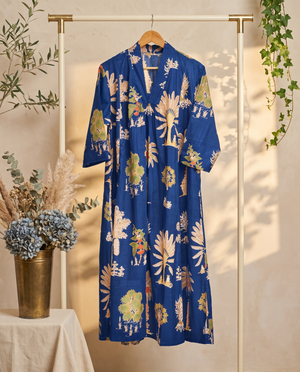
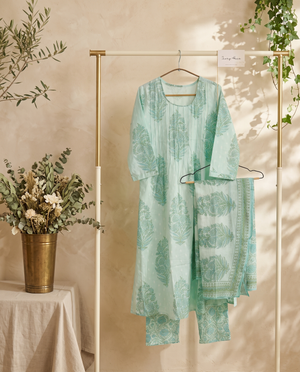
At Ivory Hues, Kalamkari-print pieces feature within our Gulmarg collection and our Sunehri collection — both include garments that carry this hand-painted-style print, translated onto easy, wearable silhouettes for Singapore's ethnic-wear occasions. The Gulmarg Haseen, for instance, is a navy blue angrakha-style kurti finished in a Kalamkari print, pairing the traditional motif language with a contemporary wrap-front cut.

Browse the full Gulmarg collection and Sunehri collection to see the current range of Kalamkari-print kurtis and suit sets available for delivery across Singapore.
Frequently Asked Questions
What is Kalamkari?
Kalamkari is a traditional Indian textile art from Andhra Pradesh in which patterns are applied to cotton fabric using natural, vegetable-based dyes, either by freehand painting with a pen or by hand block-printing. The name comes from "kalam" (pen) and "kari" (work), meaning "pen-work," and the craft is best known through two GI-protected regional styles: Srikalahasti and Machilipatnam.
What does the word "Kalamkari" mean?
Kalamkari combines the Persian-rooted word "kalam," meaning pen, with "kari," meaning work or craftsmanship — together translating to "pen-work." Before this name came into common use, the craft was known in Telugu as vratapani, meaning "writing work," reflecting its origins as a temple-textile painting tradition in Andhra Pradesh.
What is the difference between Srikalahasti and Machilipatnam Kalamkari?
Srikalahasti Kalamkari is entirely hand-painted using a bamboo or date-palm pen, traditionally depicting religious and mythological scenes from Hindu epics. Machilipatnam Kalamkari is predominantly hand block-printed using carved wooden blocks, with hand-painted detailing added afterwards, and typically favours floral, paisley, and trellis motifs shaped by centuries of export trade rather than religious narrative.
Is Kalamkari hand-painted or printed?
It can be either, depending on the style. Srikalahasti Kalamkari is fully hand-painted with no block-printing involved. Machilipatnam Kalamkari is predominantly hand block-printed, with additional fine detailing painted in by hand. Both use only natural dyes and a multi-step dyeing and washing process rather than modern chemical printing.
Does Kalamkari have a GI (Geographical Indication) tag?
Yes. Kalamkari holds two separate GI registrations under India's Geographical Indications of Goods (Registration and Protection) Act, 1999 — Srikalahasti Kalamkari, registered in 2005, and Machilipatnam Kalamkari, registered in 2008. Both are credited to Andhra Pradesh and protect the specific hand-based techniques and artisan communities of each town.
Where can I buy Kalamkari-print clothing in Singapore?
Ivory Hues (ivoryhues.sg) stocks Kalamkari-print pieces within its Gulmarg and Sunehri collections, including kurtis such as the Gulmarg Haseen in a navy blue angrakha silhouette. Both collections can be browsed online for delivery across Singapore.